|
1
|
|
|
2
|
- Motivation: Why augment when there is so much to do already?
- DL research and development trajectory
- Focus on:
- Search and discovery
- Reference
- Contributions
|
|
3
|
- Libraries assess, collect, preserve, organize, provide access to
information and promote its use to improve the human condition.
- Libraries are highly burdened to accommodate physical and electronic
materials and increasing needs for information by larger and more
diverse populations.
- Internet and WWW offer universal communication and publishing and
challenge libraries to reconsider fundamental missions--DLs
- Leverage the DL challenge to develop a broader vision of information
services for the common good: Sharium is a metaphor for this
|
|
4
|
- Information seeking is embedded in real life tasks
- People want/like to share
- altruism
- egocentrism
- investment (quid pro quo)
- peer pressure
- Innovation adoption is not a linear process
|
|
5
|
|
|
6
|
- DLs clearly must aim to collect, manage, and preserve electronic
expressions of knowledge (this is a well-established mission).
- Knowledge is in people’s heads--DLs should aim to facilitate the use and
development of the collective knowledge in human consciousness
- Human attention is a fundamental natural resource--DLs should provide
tools and resources (material and expertise) to help optimize this
resource
|
|
7
|
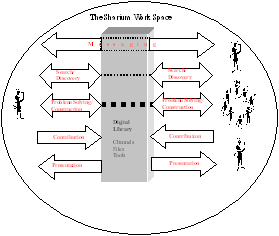
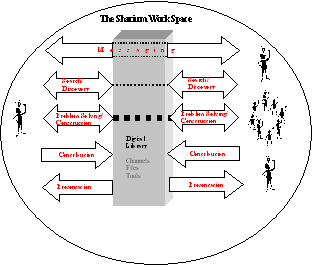
- A virtual workspace with rich content and powerful tools where people
can work independently or collaborate with each other to learn and solve
information problems. A
collaborative problem solving environment.
- Organized around resources and tools
- Encourages contributions and participation
- Is sustainable
|
|
8
|
|
|
9
|
- Interfaces
- Natural language queries
- Dynamic queries
- Alternative interfaces
- Help/support
- Consortia/portals/channels
- Interoperation
- Selection and merging
|
|
10
|
- Help people help themselves
- Elicitation
- Layered services
- Quality control
- Economic model
- Privacy
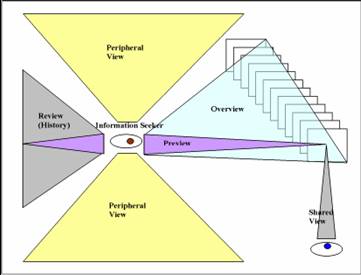
- Shared views/clients
|
|
11
|
|
|
12
|
|
|
13
|
|
|
14
|
- fostering and insuring quality control;
- transitioning information seekers from self-directed search to
reference and community assistance when people do not succeed with
self-directed approaches;
- developing layers of assistance from fully automated (e.g., FAQs),
through community assistance (e.g., posting a question to a
newsgroup), to professional assistance (e.g., online with a reference
librarian), including hybrid solutions; and
- creating interfaces that do not overwhelm or frustrate information
seekers as they transition through the various service layers.
|
|
15
|
- Time (attention)
- Materials
- physical transfer (digitization, copy)
- rights agreements
- classification (metadata)
- validation/authentication
|
|
16
|
- Developing contribution mechanisms that allow people to easily
digitize and/or transport objects;
- Managing content authority and quality;
- Insuring access (metadata formats; preservation and persistence;
provenance).
|
|
17
|
- Why do people share?
- Models?
- Creation-ownership relationship
- Creating and maintaining trust
- Quality assurance
- Sustaining participation
|
|
18
|
|
|
19
|
|
|
20
|
|

 Notes
Notes