
What are the components of a relational database and
how do they compare with what we already know?
Definitions
a database is a collection of related data
a database management system (or DBMS) is a system designed for two main purposes
a flat file database is one where all the data is contained in a single table, such as in Excel
a relational database is one in which you can store information in different tables, each containing different information that relates to information in the other tables
comparing flat file databases to relational databases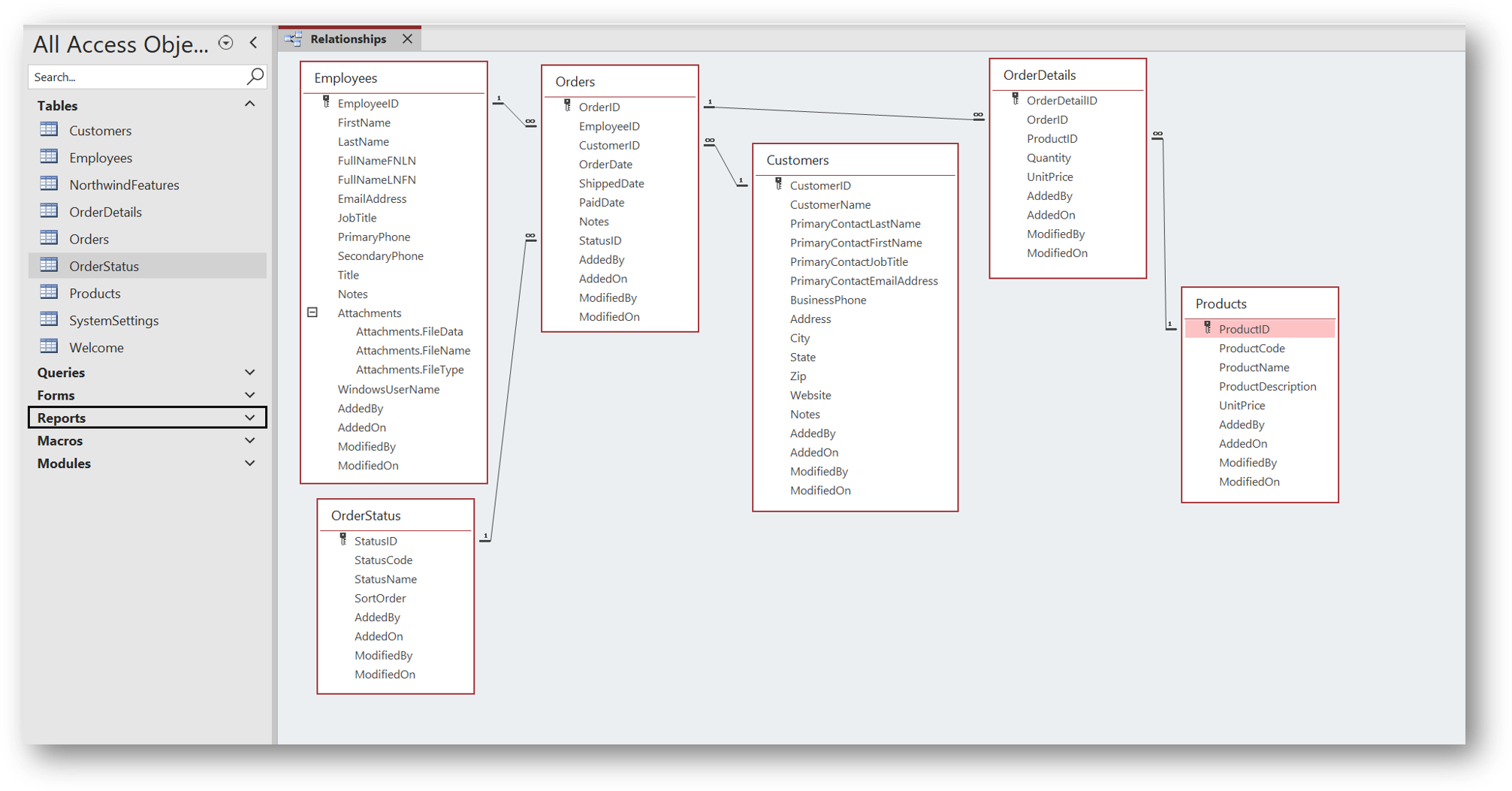
Why use a relational database design?
... an entity-relationship model (ERM) is an abstract and conceptual representation of data. Entity-relationship modeling is a database modeling method, used to produce a type of conceptual schema or semantic data model of a system, often a relational database, and its requirements in a top-down fashion. Diagrams created by this process are called entity-relationship diagrams (or ER diagrams)
One has choices in how to model the elements in a database. One of the standard textbooks on the topic (Elmasri, R., & Navathe, S. (2011). Fundamentals of database systems. Boston: Addison-Wesley.) offers a view of the several methods.
The purpose of a database is to store information about certain types of objects.
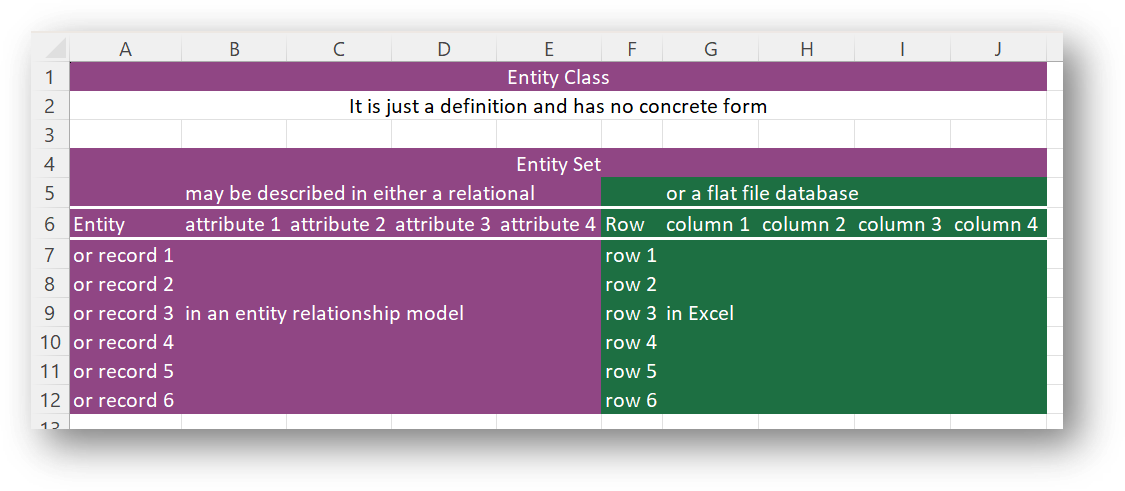
To make the distinctions clear, we will use a color schema in which we use terms relevant to entity relationship models and their correlates in Excel
An entity class [like books] is an abstract definition of something
In Excel, there is no correlate as it is just a definition, not an example of a definition
An entity set is the list of given entities within a given entity class that are currently in the database
In Excel, an ERM entity set is an Excel table
an entity [like a textbook for INLS161] is a concrete example of that description
In Excel, an ERM entity is an Excel row
An entity is composed of attributes
in Excel, RRM attributes are Excel columns
ERM attributes/Excel columns include information we want in the database
ERM attributes/Excel columns help to uniquely identify individual entities within a class
ERM attributes/columns can describe relationships between entities in different classes
a Primary Key
is a set of attributes/column cells that uniquely identifies an entity/a row
a Foreign Key
is a copy of the Primary Key
of one entity/row
that appears as
an attribute/column cell
in another entity class/worksheet
and helps define the relationship between
entities/rows
in the two entity classes/worksheets
these keys link together the related entities/rows in a relational database/entity set