|
1
|
- Gary Marchionini
- University of North Carolina
- march@ils.unc.edu
|
|
2
|
- Need to choose
- product testing
- controlled comparisons
- Need to assess
- system performance
- outcome research (e.g., social programs)
- Need to understand
|
|
3
|
|
|
4
|
- Library Effectiveness
- circulation
- collection size
- reference encounters
- satisfaction
- Information Retrieval
- recall/precision tradeoff
- satisfaction
|
|
5
|
- Count stuff
- Volumes, circulations, reference questions
- Transaction log equivalents in DLs?
|
|
6
|
|
|
7
|
|
|
8
|
|
|
9
|
- D’Elia & Walsh LQ article (physical libraries)
- Satisfaction complexity (direct, indirect)
- Results must be contextualized
- See LibQual (www.libqual.org) for ARL/TAMU
- See http://www.vuw.ac.nz/~agsmith/evaln/
- See http://www.library.ucla.edu/libraries/college/help/critical/
- MIT Press book Fall 03
|
|
10
|
- Recall and Precision metrics
- System performance (e.g., response time, broken links, etc.)
- Satisfaction
- Usability?
|
|
11
|
- Today’s IR systems are not comparable to paper-based systems.
- bibliographic, full-text, and multimedia IR systems are not comparable
- Complex systems are greater than the sum of their respective components.
- systems that include human components are inherently complex
- Information seeking is an interactive process.
- different users, domains, and settings require distinct IR system
capabilities
|
|
12
|
|
|
13
|
|
|
14
|
- TREC ad hoc and routing evaluations
- TREC interactive track
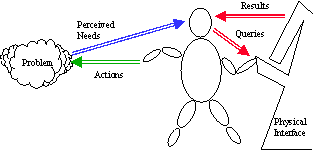
- introduces the user as a component but not the problems, perceived
needs, and actions
- Hybrid solutions
- human + automatic
- statistical + natural language processing
|
|
15
|
- Does the patient recover?
- Were good decisions made?
- patient, physician, hospital, HMO views?
- Difficult (impossible?) to disambiguate component effects
- Task-oriented studies (e.g.., Hersh’s medical student decisions)
|
|
16
|
- Think aloud protocols
- Observations, Transaction log analysis
- Interviews, Stimulated recall
- Error analysis
- Time on task
- Cost-benefit analysis
- Questionnaires
- Simulations
|
|
17
|
- Given many relevant documents, which can be most easily
processed/understood?
- What are the cost-benefits to different stakeholders?
- What are the organizational/institutional changes due to a system?
- What are the most useful surrogates (representations) for multimedia
objects?
- How to best integrate results
- multiple retrieved sets
- multiple evaluation efforts
|
|
18
|
- Consider the information seeker’s context
- Cognitive accessibility (it does not matter how good the results are if
the information cannot be easily understood)
- Cost-benefit assessment (it does not matter how good results are if
there is no time to use it)
- Study special populations (cell biologist vs. practicing physician)
- Usability testing approach (iterative, impressionistic)
- Systematic case studies
- Epidemiology approach (start with outcomes and trace influences)
- Develop an IR interaction model
|
|
19
|
- Multiple stakeholders, methods, and components
- A set of evaluation questions (learning, teaching, system, publishing)
- Longitudinal effects
- mechanical advantages
- side effects
- new types of learning and teaching
- systemic change
|
|
20
|
- “We may never know quantitatively the impact of these combined effects,
partly because we don’t know what would have happened without the
collaboratory.”
- William Wulf, The National
Collaboratory--A White Paper, 1989
|

 Notes
Notes