|
1
|
|
|
2
|
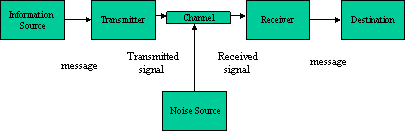
- The technical (engineering) problem
- A problem solving strategy: simplify and model
- Unit of information is the bit (binary digit)—unit of choice or
uncertainty
- Rate of information flow—(bits per second) also called the entropy (rate
of reducing uncertainty)
- Channel capacity--bandwidth
|
|
3
|
|
|
4
|
- Then, information is the amount of uncertainty in the SOURCE (not the
message). This the amount of
entropy (randomness).
“Information is a measure of one’s freedom of choices when one
selects a message.” P. 9
- Weaver discussed three levels of communication problem
- Accuracy of transmission (technical problem)
- Degree of meaning (semantic problem)
- Effect of transmission (effectiveness problem)
- Do not confuse information with meaning!!
|
|
5
|
- 1. RSVP yes or no?
- When you reply, you reduce my uncertainty by 1/2, requires only 1 bit
to achieve—the minimal amount of information
- 2. A 32 icon language.
- When the destination receives/selects one, the uncertainty is reduced
by 31/32, requires 5 bits (log322=5), five times as much
information as the RSVP. So,
selecting (or giving a command) a single character/icon in a 32 language
reduces uncertainty (provides more information) than selecting a
character in a 2 character language.
- Assumes independence of each ‘choice’
- For more typical settings, conditional probability arises (e.g., if the
receiver has received a ‘Q’ in and English word message, the next letter
carries 0 information since it does not reduce any uncertainty (we are
sure it will be an ‘U.’ This
gives rise to coding theory.
|
|
6
|
- Suggests that Shannon’s work inspired Chomsky and others to look for
semantics in structure (syntax), which in turn inspired psychologists
(e.g., Miller) and we might extend to say initiated the cognitive
sciences and the debates about whether meaning is constructed by the
receiver (context bound) or inherent in the message.
- Pierce: Communication is a process of adjusting understandings and
attitudes, of making them congruent or ascertaining how and where they
agree or disagree. Common
language is NOT as important as a common interest. However, perfect common interest
(knowledge) makes communication impossible (no information can
exchange)—we need to be surprised within our context ala Shannon.
- This debate is related to arguments about relevance and indexing that
are central to information science.
- We aim to balance order and randomness/novelty. Can we data mine the order that
escapes us (through biometrics or transaction logging)? What are implications for information
design and services?
|
|
7
|
- Pierce discusses communities of interest and relates to mass
communication trends.
- This discussion introduces some of the issues of popular (mass)
communication. How do his speculations about trends in periodicals
(rising at the time) and newspapers (static), look today? Internet impact? See Statistical
Abstracts
|
|
8
|
- Cybernetics introduced homeostasis—balance through feedback.
- Pierce relates to politics and social control (consider the time this
was written). Is open source
software movement a homeostatic movement? ;-)
- Homeostasis addresses information deficiency and overload—both issues of
our time.
|

 Notes
Notes