
A network of networks with no one, and everyone, in charge."As we may think" - Vannever Bush, 1945
But with a structure that everyone uses.
A bit of background - Foreseeing the future: The legacy of Vannevar Bush, by Erin Malone, Boxes & Arrows, 16 Jun 2002
Bush's vision for how we handle and interact with information took a step towards reality with the creation of hypertext and the basic linked web, but those of us working with information and creating information spaces and connections would do well to take another look at his vision and be as inspired to create new and innovative ways to gather and share information as other have been in the past.
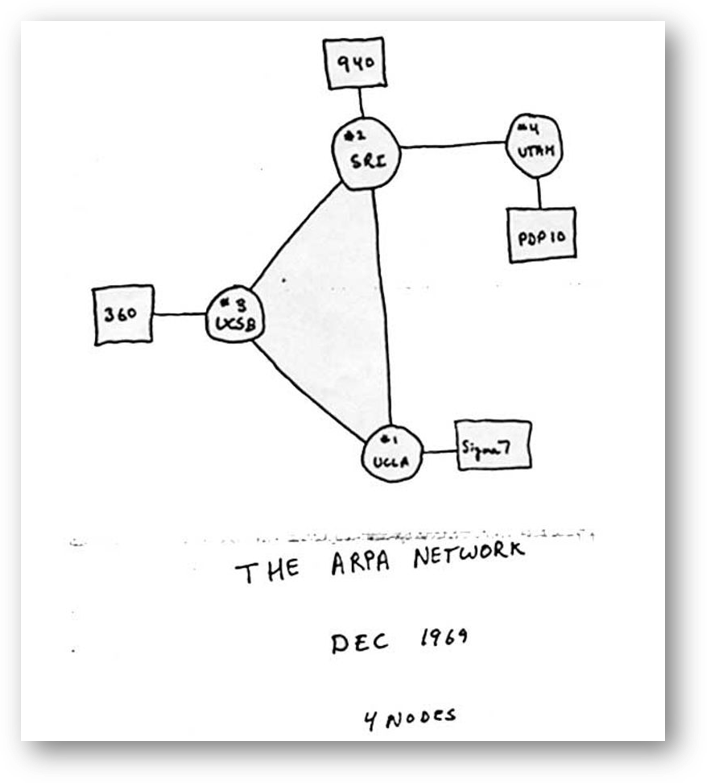
In 1958, the U.S. government formed the Advanced Research Projects Agency (ARPA) within the Defense Department and gave it a mission to ensure U.S. leadership in science and technology with military applications. Over time, ARPA evolved into the Defense Advanced Research Projects Agency (DARPA). In 1969, ARPA established ARPANET, the forerunner of the Internet.
ARPANET was a network that connected major computers at the University of California at Los Angeles, the University of California at Santa Barbara, Stanford Research Institute, and the University of Utah. Within a couple of years, several other educational and research institutions joined the network.
ARPANET was designed to allow continued communication if one or more sites were down. At its heart, ARPANET, and the Internet that evolved out of it, were designed as reliable communications tools.
ARPANET history (if you want more) by Michael Hauben at Columbia
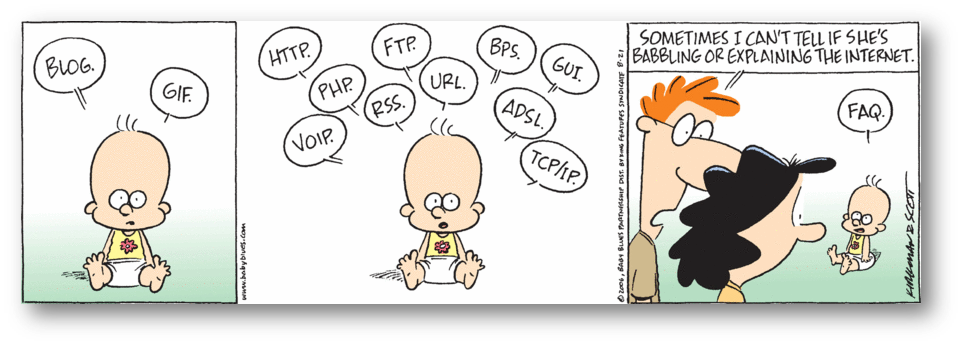
Throughout the 1970s, developers created the protocols used to transfer information over the Internet. By the early 1980s, Usenet newsgroups and electronic mail had been born. Most users were affiliated with universities, although libraries began to connect their catalogs to the Internet, too. During the late 1980s, developers created indices, such as Archie and the Wide Area Information Server (WAIS), to keep track of the information on the Internet. To give users a friendly, easy-to-use interface to work with, the University of Minnesota created its Gopher, a simple menu system for accessing files, in 1991.

No one authority controls the World Wide Web. Today's web site authoring tools allow virtually anyone who has access to a computer and the Internet to post a Web site and contribute to the definition of what this medium is and what it can do. But the World Wide Web Consortium does oversee the development of Web technology.
You shape the Web
According to Tim Berners-Lee,
The dream behind the Web is of a common information space in which we communicate by sharing information. Its universality is essential: the fact that a hypertext link can point to anything, be it personal, local, or global, be it draft or highly polished.
With the development of tools that allow us to create Web sites without having any knowledge of hypertext markup language (HTML), this dream is being realized. When we create our own web sites in this course, we will be one of the forces shaping this "common information space".
Keeping an eye on the standards of Web technology is W3C, formed by Berners-Lee in 1994. An international group of industry and university representatives, W3C promotes the Web by developing common protocols for transmitting information over the Internet. The consortium provides information, reference code, and prototype and sample applications to developers and users. It is hosted by the Massachusetts Institute of Technology's Laboratory for Computer Science in the United States, the Institut National de Recherche en Informatique et en Automatique in Europe, and the Keio University Shonan Fujisawa Campus in Japan.

Domains divide World Wide Web sites into categories based on the nature of their owner, and they form part of a site's address, or uniform resource locator (URL).
ICANN (Internet Corporation for Assigned Names and Numbers) has overall responsibility for managing the Domain Name System. It controls the root domain, delegating control over each top-level domain to a domain name registry.
Originally there were only a few common top-level domains (TLD), but that has changed. The IANA lists numerous variations. Each country linked to the Web has a two-letter top-level domain. For example, .de is Germany, .fr is France, .ie is Ireland, and .tv is Tuvalu.
Existing Generic TLDs
Many state and local governments use the country domain system