Information Management for Organizational Effectiveness
Wednesday, 22 Oct 2025 | Organizational leadership models
There are a number of different theories of leadership.
We will consider a few and identify how we fit into their definitions.
Start by watching a discussion on leadership being a choice
"Leadership is not a talent or a gift. It's a choice. It's not complex, but it's very hard." General Stanley McChrystal explains to a packed auditorium of 600 at Stanford Graduate School of Business. McChrystal shares his perspective on leadership and influence discussing the importance of understanding culture, leading by example, building trust, and creating a common goal within a team.
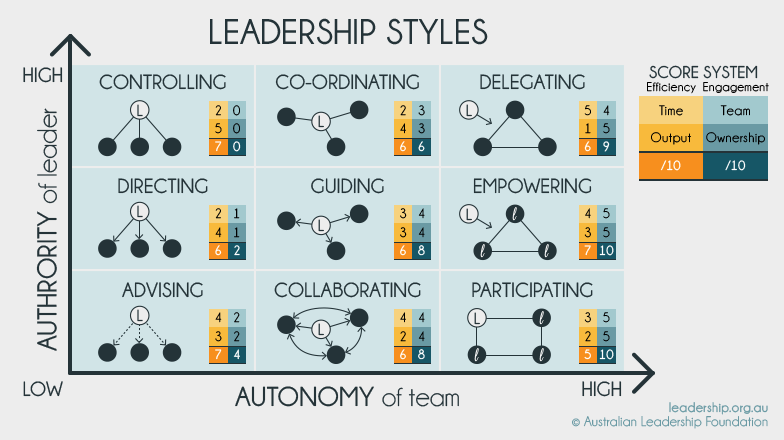
To prepare yourselves for the session ...
... take the What's Your Leadership Style? quiz and come prepared to discuss your results
You don't have to read these unless you wish to ...
... but we might touch upon them in conversation

Most developmental psychologists agree that what differentiates one leader from another is not so much philosophy of leadership, personality, or style of management. Rather, it's internal "action logic"--how a leader interprets the surroundings and reacts when his or her power or safety is challenged ...
a typology of leadership based on the way managers personally make sense of the world around them. Rooke and Torbert classify leaders into seven distinct action/logic categories ... the first three associated with below-average performance, the latter four with medium to high performance ...
executives who are willing to work at developing themselves and becoming more self-aware can almost certainly move toward one of the more effective action logics ...
- Rooke, D., & Torbert, W. R. (2005, Apr). 7 transformations of leadership. Harvard Business Review, 66-76.
But also consider this reality in the context of the transformations noted above.
Studies find that plenty of confident egomaniacs, unsuited to the subtleties of management, get a leg-up for being, well, confident egomaniacs ...
conscientious but unprepossessing characters tend to have little-noticed but precious advantages. They can be depended on to make decisions calmly, manage teams deftly and be emotionally mature. They deserve promotion ahead of co-workers with “flash and vision, and bold displays of confidence” ...
- Business | Bartleby: Unshowy competence brings drawbacks as well as benefits, The Economist, 23 February 2023.