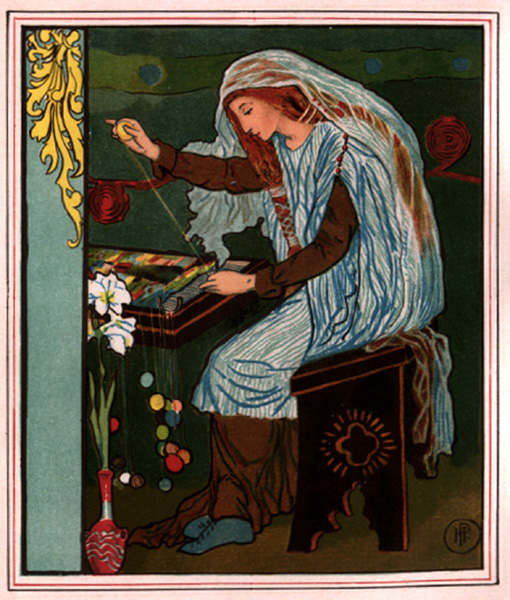
Pyle, Howard (1853-1911), "The Lady
of Shalott Weaving," from: Tennyson, Alfred. The Lady of Shalott.
Decorated by Howard Pyle. New York: Dodd Mead & Co., 1881.
Yarn
(yärn) n. [ME. < OE. gearn, yarn, akin to G. garn <
IE. base *ĝher-, intestine, whence L. haru-spex, soothsayer,
lit., intestine-seer, Gr. chordē (cf. cord)] 1.
any fiber, as wool, silk, flax, cotton, nylon, glass, etc., spun into
strands for weaving, knitting, or making thread.
2. coarse fibers woven into strands for rope-making.
3. [Colloq.] a tale or
story, esp. one that seems exaggerated or hard to believe – vi. [Old
Colloq.] to tell yarns – spin a yarn [Colloq.] to tell a yarn. (Webster’s
New World Dictionary, 2nd College Ed. New
York: Simon and Schuster, 1984, p.
1646)
With the recent resurgence
in interest in handcrafts such as knitting, weaving and spinning, yarn becomes a
topic of interest as well. While
many people begin and end their creative lives happily by simply learning the
how to-s of a craft, others want to learn more about the materials that they
use. They want to know and
understand relationships between fibers and yarns, how processing and
manufacturing affects yarn, and how their choice of a yarn will affect a
project’s final appearance. They
want to learn fiber properties so that they can make informed decisions about
their materials. By learning more
about yarn, needle workers and fiber artists gain knowledge, control, and
expertise over their craft as well. They
will know what to expect when they knit up a hank of silk or merino wool before
they have put in the financial investment and the long hours of creative work.

The purpose of this
pathfinder is to provide more in-depth information about natural fiber yarns
to a non-technical, but knowledgeable, audience of hand crafters and fiber
artists than is readily available at a local library or bookstore.
Since the yarn that is used in handcrafts is also used in manufacturing
textiles and fabric, many of the sources discussed will touch on these topics as
well.
The resources provided in
this pathfinder are limited to those accessible in North Carolina State
University’s (NCSU) Burlington Textiles Library. The Burlington Textiles Library is easily accessible to the
general public, since one can get a free daily visitor’s parking pass at the
entrance to the university’s Centennial Campus to use the parking lot adjacent
to the Textiles building. Further,
the Burlington Library has a large collection of textile-related materials, as
well as access to on-line databases and locally mounted CD-ROMs.
A note on spelling:
The American English spellings of words such as fiber and color are used
throughout this pathfinder unless they are part of the title of the work or a
quotation from a work that uses British English spellings.
Locations:
All the materials in this
pathfinder can be found in the Burlington Textiles Library at North Carolina
State University in Raleigh, NC. If
the source is part of Burlington’s non-circulating reference collection, it
has the annotation “Ref” as part of its call number.
Periodicals are shelves separately in alphabetical order.
The following subjects are
a selection of those most relevant to the topic from the Library of Congress
Subject Headings. They can be used
to do subject searches in NCSU’s online catalog:
¨
Textile
¨
Textile – extensive subheadings
¨
Textile Craft
¨
Textile Fabrics
¨
Textile Fibers
¨
Textiles
¨
Yarn
¨
Yarn – extensive subheadings
¨
Yarns
Browsing
Areas:
The call numbers below
list areas in the stacks of the Burlington Library where relevant materials may
be found by browsing:
¨
TS 1300 – 1770 for information
on fibers
¨
TT 698 – 848 for information on
crafts
Frequently
Mentioned Sources:
These items are frequently
mentioned in the bibliographies of other works. They are a good place to begin learning about yarn and to
gather additional sources of information.
Joseph, Marjory L.
Essentials of Textiles. 3rd
ed. New York:
Holt, Rinehart and Winston, 1984.
TS 1445.J63 1984
This book is a companion
volume to the text below. It is
geared toward non-textile majors and general readers.
Its outline is similar to Introductory Textile Science, but
includes a chapter on legislation affecting textiles. It also includes metric conversions, a glossary,
bibliography, illustrations, and index.
Joseph, Marjory L.
Introduction to Textile Science.
5th ed. New York:
Holt, Rinehart and Winston, 1986.
TS 1445.J64 1986
This book is the latest
edition that the Burlington library has on its shelves.
It, along with its companion volume, is one of the two standard textile
textbooks in the discipline that is most frequently cited.
This text is the more technical version of the two and contains chapters
on fiber theory and classification, both natural and manmade fibers, fabric
finishes, and end use. It has
metric conversion tables, a bibliography, glossary and index.
Kolander, Cheryl.
A Silkworker’s Notebook. Rev.
ed. Loveland, CO:
Interweave Press, 1985.
TS 1546.K66 1985
This source is mentioned
in almost every text where silk is a topic.
It provides a history, an overview of the fiber, a discussion on types of
silk yarns, and how to knit and weave using silk. It is illustrated with both color and black and white
photographs and includes a bibliography, glossary and index.
The Textile Institute.
Textile Terms and Definitions.
Ed. McIntyre, JE and PN Daniels. 10th
ed. Manchester, UK:
The Textile Institute, 1995.
Ref TS 1309.T47 1995
This dictionary of the
textile industry was first published in 1954 and is now in its 10th edition.
In addition to an alphabetical listing of terms relevant to the textile
industry, it includes information on yarn numbering and counting systems,
conversion factors, and the classification of fibers.
It is illustrated.
Tortora, Phyllis G. and
Robert S. Merkel. Fairchild’s
Dictionary of Textiles. 7th ed.
New York: Fairchild
Publications, 1996.
Ref TS 1309.F34 1996
This is one of the best
sources of information surveyed in this pathfinder, and it is rightfully a
frequently mentioned source. It is
a “basic reference for those working in the textile industry” (preface).
To be useful to both professionals and general consumers, it contains
extended definitions, a pronunciation guide, photographs and illustrations, and
a bibliography. Further, it includes a list of textile-related organizations
such as handcraft guilds.
Von Bergen, Werner, ed.
Wool Handbook. 4th
ed. 2 vols.
New York: John Wiley and
Sons, 1970.
TS 1631.V6 1970
This source touts itself
in its preface as “a text and reference book for the entire wool industry
prepared by a staff of specialists.” It
is a two-volume work with the second volume being in two parts.
Volume 1 gives the historical and economic background of sheep raising
and the wool industry, and Volume 2 provides details of wool manufacturing and
marketing.
Encyclopedias:
Encyclopedias are a good
source of introductory information on a topic.
They emphasize breadth rather than depth, and can lead to further
exploration of a topic through the use of their bibliographies.
These encyclopedias generally cover textiles and all that is related to
them, including the yarns and fibers from which they are made.
Entries are usually arranged alphabetically.
American Fabrics and
Fashions Magazine. Encyclopedia
of Textiles. 3rd ed.
Englewood Cliffs, NJ: Prentice
Hall, Inc., 1980.
Ref TS 1445.A18 1980 folio
“An illustrated and
authoritative source book on textiles, presenting a complete and practical
coverage of the entire field – its history and origins, its art and design,
its natural and manmade fibers, its manufacturing and finishing processes, color
and dyes, textile printing, specialty end uses” (title page).
It also contains a comprehensive dictionary of textile terms.
Moreover, this work contains biographical information about those who
have influenced textiles. It is
profusely illustrated.
Dillmont, Therese.
The Complete Encyclopedia of Needlework.
3rd ed. Philadelphia, PA:
Running Press, 1996.
Ref TT750.D57 1996
This source is an
exhaustive list of needlework technique. It
is filled with illustrations and examples, and is frequently cited in other
works as a standard reference.
Grayson, Martin, ed.
Encyclopedia of Textiles, Fibers and Nonwoven Fabrics.
New York: John Wiley and
Sons, 1984.
TS 1309.E53 1984
The emphasis of this
encyclopedia is on fibers. It is a
collection of full text articles by industrial and academic experts meant for
those who manufacture and use fibers, textiles, and fabrics. It is a more technical treatment of the subject than most of
the other sources in this pathfinder. It
is organized alphabetically, with cross references, footnotes, an index,
conversion factors and a list of abbreviations.
Jerde, Judith.
Encyclopedia of Textiles. New
York: Facts on File, 1992.
Ref TS 1309.J47 1992
This book is an
alphabetical listing of fabrics, fibers, short biographies, manufacturing
processes, and other information relevant to textiles.
It is profusely illustrated with both photographs and drawings and
includes a bibliography.
Handbooks:
Handbooks are similar to
encyclopedias in that they generally provide a reader with a broader coverage of
a topic than one normally finds in a book.
The handbooks in this section are usually organized by topic and include
more in-depth information than the encyclopedias.
Cook, J. Gordon.
Handbook of Textile Fibres. 5th ed.
2 vols. Durham, UK: Merrow
Publishing, Ltd., 1984.
TS 1540.C65 1984
This handbook is divided
into two volumes – the first dealing with natural fibers and the second with
manmade ones. Its intended audience
is anyone in the textile trade who requires “a background of information on
fibres (sic) to help them in their work” (Preface).
It provides exhaustive coverage of natural fibers, their history, and
their fundamental properties. It
includes such arcane fibers as vicuna, ramie, and sisal.
It provides an index, illustrations, and photographs.
Held, Shirley E. Weaving:
A Handbook of the Fiber Arts. 3rd
ed. New York:
Harcourt Brace College Publishers, 1999.
TT 848.H43 1998
This textbook is a good
introduction to the fiber arts. It
is divided into four major sections that discuss history; origins, methods and
materials; hand weaving and dyeing; and the world of fibers.
It contains both color and black and white photographs, a glossary,
bibliography, an appendix on safety issues related to fiber artists, sources,
and conversions charts.
Needles, Howard L.
Handbook of Textile Fibers, Dyes and Finishes.
New York: Garland STPM
Press, 1981.
TS 1540.N43
The aim of this book is to
discuss the structural, physical, chemical and end-use properties of major
textile fibers. It also includes
information on textile finishes and dyes. While
this source is the most technical one included in this pathfinder, it is
included because of its readability. It
challenges the non-technical reader but is not overwhelming.
It includes an index, illustrations and photographs.
Von Bergen, Werner.
Textile Fiber Atlas: A
Collection of Photomicrographs of Common Textile Fibers.
New York: American Wool
Handbook Company, 1942.
TS 1540.V6
This book contains a
series of black and white photographs of various natural fibers and accompanying
introductory remarks. The list of
natural fibers is extensive which is the main value of the source.
This book can help a fiber artist to visualize what yarns made out of a
given fiber might look and feel like when used in a project.
Given the date of publication, the coverage of manmade fibers is minimal.
The book includes a bibliography.
Dictionaries:
Dictionaries are generally
thought of as providing definitions, pronunciation, and alphabetical word lists
to aid a person in learning new words. In
the field of textiles, however, encyclopedias and handbooks generally fulfill
that task while the dictionaries provide polyglot word lists so that terms can
be accurately translated between languages.
Kenyon, JR, ed.
The Kendale Glossary of Basic Textile Terms Compiled in Five Languages
and Edited in the Countries of Origin.
Huddersfield, UK: Kendale Publications, Ltd., 1990.
Ref TS 1309.K46 1990
This dictionary is an
alphabetical listing of textile terms in English with their German, Spanish,
French, and Italian equivalents. It
is word list: there are no
definitions of the terms included. It
contains an alphabetical listing of all the words at the back so that a
non-English speaker can find foreign language equivalents as well.
The source also contains advertisements.
Vincenti, R., ed.
Elsevier’s Textile Dictionary.
New York: Elsevier, 1993.
TS 1309.V56 1993
This book is a second
polyglot dictionary of textile terms. It
is equivalent to the Kendale glossary, and it is useful for translating fiber
information from imported yarns.
Bibliographies:
Bibliographies provide
lists of further sources of information for users. Annotated bibliographies also give summaries of the sources
listed to further aid readers in finding relevant information.
Buschman, Isabel.
Handweaving: An Annotated Bibliography.
Metuch, NJ: The Scarecrow
Press, Inc., 1991.
Ref TT 848.B87 1991
This book provides
extensive references for yarns and fibers.
Moreover, its chapters include processes and projects, history and
artistry, Native American weaving, other reference works, and periodicals.
The book is arranged topically, but is indexed by author, title and
subject.
Farnfield, Carolyn A., ed.
A Guide to Sources of
Information in the Textile Industry. Manchester,
UK: The Textile Institute, 1974.
Ref TS 1312.F37
This book contains
information on textile organizations, periodicals, abstracts, books,
directories, dictionaries, standards and specifications, patents, and
statistical sources. It is an old
book, but a unique one, and therefore essential to this pathfinder.
Burlington’s copy has been partially annotated in pencil to reflect the
library’s holdings and to provide more up to date information.
Royal Historical
Society Bibliography
This database is locally
mounted on the NCSU system and can be used in the Burlington Textiles Library.
It is a CD-ROM version of a print bibliography that focuses on the
history of Britain, Ireland and the British overseas.
The Oxford University Press published it in 1998. Searches using
“yarn” and “handicrafts” resulted in references relevant to this
pathfinder.
Directories:
Directories provide a list
of resources, organizations, people and how to contact them.
The directories most relevant to needle workers and fiber artists provide
information about suppliers, organizations, and services useful to them.
Larson, Lois.
Software Directory for Fibre Artists.
Camrose, Alberta, Canada: n.
p., 1995.
TT 848.L3755 1995
While this book is a
little dated given its subject matter, it is one of the few that provides
information to the fiber artist about computer resources.
It includes a directory of stand-alone software programs for both Macs
and PCs for home use, a directory of books that include software, a directory of
standard industry software programs, and a directory of other resources for
fiber artists.
McRae, Bobbi.
The New Fiberworker’s Sourcebook.
Austin, TX: Fiberworks
Publications, 1993.
TT 698.M38 1993
This book is “an
essential mail order guide to supplies and services for the fiber arts including
thousands of sources for weaving, spinning, knitting, crochet,” etc. (cover).
It also provides information on fiber-related museums, collections,
living history exhibits, videos, and educational opportunities.
It also provides a list of recommended reading and basic fiber facts in a
down-to-earth and congenial style. While
the book is beginning to show its age, the list of sources is so exhaustive that
much of the contact information is still usable.
Quinn, Celia.
Yarn: A Resource Guide
for Handweavers. Loveland, CO:
Interweave Press, Inc., 1985.
TS 1449.Q56 1985
This book is primarily
directed toward spinners and weavers. It
is a collection of black and white photographs of yarns and includes
descriptions of fiber content, style of fiber (e.g., smooth, slubbed, etc.),
yardage per pound, and the like. It
also contains an accompanying text that explains the properties of the natural
fibers, how the yarn is prepared for use, and some technical information.
Moreover, it contains a short glossary, a bibliography, and a
suppliers’ directory.
The books listed in this
section attempt to give the reader a broad range of topics related to fibers,
yarns, and handcrafts. Most of the
books here contain bibliographies that can provide further in-depth information
if desired.
Batchelder, Ann and Nancy
Orban, eds. Fiberarts Design
Book 5. Asheville, NC: Lark Books, 1995.
TT 699.F525 1995
This book is a source of
inspiration for fiber artists. It
is a museum-quality fiber arts exhibition between two covers.
It contains color photographs of and written commentary on the work of a
variety of fiber artists in a variety of media.
Chapters include such titles as surface design, wearables, needlework,
and tapestry. The Burlington library also owns the four previous books in
the series.
Elsasser, Virginia.
Textiles: Concepts and Principles.
New York: Delmar Publishers,
1997.
TS 1760.E47 1997
This book is a good
introduction to textiles for “students who are planning careers that require a
basic knowledge of textiles” (Introduction).
It provides extensive coverage of fibers, yarns, and fabrics.
It is both a classroom text and a laboratory manual that provides a
non-technical treatment of the subject. It
has no bibliography, but its glossary is extensive and its illustrations good.
Hochberg, Bette.
Handspinner’s Handbook. Santa
Cruz, CA: Bette and Bernard Hochberg, 1980.
TT 847.H59 1980
This self-published
pamphlet can be found in many bibliographies dealing with fiber crafts.
Three fourths of the work provides information on various natural fibers
and the yarns and threads that result from their spinning.
It contains drawings and black and white photographs, along with a short
bibliography.
Labarthe, Jules.
Elements of Textiles. New
York: Macmillan Publishing Co.,
Inc., 1975
TS 1445.L19
This college home
economics textbook provides basic knowledge of textile products, their
evaluation, use and care. It begins
with chapters on fibers, then it moves to yarns, textile manufacturing, and
selection. It contains a
bibliography, index, glossary, illustrations, important conversion factors, and
an appendix on yarn numbering and counting.
Lambert, Patricia, Barbara
Staepelaere, and Mary G. Fry. Color
and Fiber. West Chester, PA:
Schiffer Publishing, Ltd., 1986.
TT 699.L35 1986
This book fills a niche
for those interested in yarn because it concentrates on the use and control of
color by and for fiber artists. It
provides a primer on color theory, and discusses fiber structure with respect to
its relationship to light and color. It
provides practical solutions to color problems a fiber artist might encounter
and a list of projects. It is
heavily illustrated and includes a glossary, index and bibliography.
Lorant, Tessa.
Yarns for Textile Crafts. New
York: Van Nostrand Reinhold
Company, Inc., 1984.
TT 699.L67 1984
This is the best
introduction to yarn for the beginning fiber artist. It contains a primer on yarns, including definitions, fiber
properties and characteristics, individual chapters on both natural and manmade
fibers, spinning, and yarn thickness. It
includes a glossary, bibliography and index.
Taylor, Marjorie A.
Technology of Textile Properties.
3rd ed. London:
Forbes Publications, Ltd., 1990
TS 1445.T28 1990
This book is a useful
introduction to textiles. It
includes chapters on fibers, yarns, fabric construction, dyeing, printing, and
fabric finishing, fabric properties, and labeling.
It also includes a further reading guide divided by topic and an index.
Historical
Sources:
Yarn and textiles have a
long history that is beyond the scope of this pathfinder.
However, because they do have such a long history, any pathfinder dealing
with yarn would be incomplete without at least one or two sources that could
provide a reader with a starting point for further exploration.
Godeys Ladys Book,
1830-1880
This source is a database
locally mounted in the Burlington library and is part of the Accessible Archives
Search and Information Server. It
provides text and images from Godey’s Ladys Book from 1830 to 1880.
Of interest to this pathfinder are the handcraft patterns and information
concerning sewing and other needlework that can be found using the server’s
search engine.
Harris, Jennifer, ed.
Textiles, 5000 Years: An
International History and Illustrated Survey.
New York: Harry N. Abrams,
1993.
NK 8806.T45 1993
This is a beautifully
illustrated book containing essays about textiles in chronological order.
It begins with a survey of textiles in the ancient world and then touches
on such exotic topics as Byzantine silks, and Palestinian embroidery as it moves
through history to conclude with a geographically diverse survey of modern
textiles. It also includes an index, bibliography, and maps.
Kissell, Mary Lois.
Yarn and Cloth Making: An
Economic Study. New York:
The Macmillan Company, 1918.
TS 1445.K5
This book is an old home
economics textbook. It is filled
with illustrations, and given its age, has an extensive bibliography of works
dating back to the 1820s. Moreover,
it provides bibliographic information for its illustrations that include
drawings and photographs from the National Geographic Magazine and other
reputable sources. It contains
chapters on hand spinning and weaving that still provide valuable information.
Indexes
& Abstracts:
Indexes and abstracts
provide bibliographic and abstract information about journal and periodical
articles, books, conference proceedings, dissertations, and other scholarly
works. They are an invaluable
source for up to date discussions of topics of interest.
Textile Technology
Database
This database is locally
mounted on the NCSU system and can be used in the Burlington Textiles Library.
It provides abstract coverage of current journals, books, vertical file,
and other collections of the Roger Milliken Textile Library in textile
technology and related fields. Its
coverage is from 1978 to the present (Summer, 2000).
Searches by specific fiber (e.g., wool, flax), handcraft, and various
specific handcrafts provided useful journal and periodical references that were
available in the Burlington Library.
ABI/Inform
This database is mounted
on the general NCSU system and can be used in the Burlington Textiles Library.
It provides bibliography, abstract and some full text coverage of
“worldwide literature in business and management, accounting, economics,
finance, taxation, marketing, real estate, public administration, labor
relations, health care, banking and insurance” (from the NCSU Library catalog
description). It is updated
continuously and provides indexing coverage from 1971 on, full text coverage
from 1991 on, and images from 1987 on. Again,
doing some basic searches on relevant topics yielded promising results.
World Textiles (via
Silverplatter)
This database can be used
in the Burlington Textiles Library. It
provides bibliographic coverage of the textiles industry, textile technology,
and the applications of textile materials.
It covers both English and foreign language books, periodicals,
proceedings, scientific papers, European patents and standards, and directories.
It is updated quarterly and it coverage begins with 1970 (from the NCSU
Library website description).
Dissertation Abstracts
This database is online at
NCSU via Silverplatter. It provides
coverage of PhD. dissertation and selected Masters’ theses from 1981 to the
present. Searches on this database
yielded references dealing mainly with historical aspects of the topic.
Journals:
The Burlington Textiles
Library has an extensive collection of journals relevant to this pathfinder.
Those listed below are only a small representation of those that are
currently received by the library that often include non-technical articles.
These journals are shelved alphabetically.