|
INSTRUCTIONAL DESIGN PROCESS |

(Notes taken from Philip Turner’s Helping Teachers Teacher (Libraries Unlimited, 1993) and Walter Dick's (et al) Thje Systematic Design of Instruction. 5th ed. Longman, 2001)
INSTRUCTIONAL DESIGN |
|
|
INSTRUCTIONAL DESIGN PROCESS |
(Notes taken from Philip Turner’s Helping Teachers Teacher (Libraries Unlimited, 1993) and Walter Dick's (et al) Thje Systematic Design of Instruction. 5th ed. Longman, 2001)
A standard instructional design model is based on the systems approach and is used as a problem-solving tool. It involves the following steps:
- Identification of problem based upon needs
- Identification of solution requirements
- Determination of different strategies to solve problem
- Selection of best strategy for the purpose
- Implementation of strategy
- Determination of effectiveness
- Implementation of required revisions
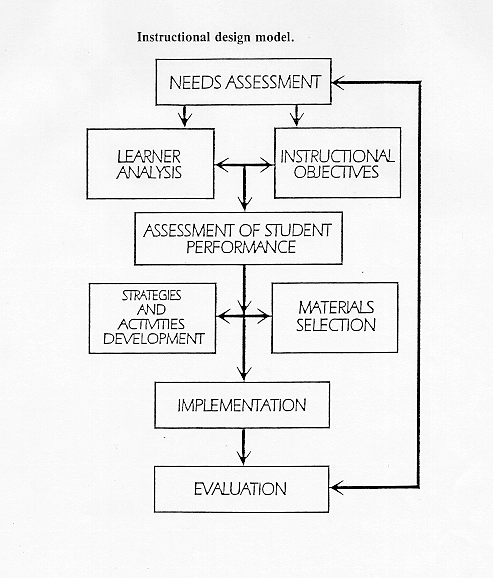
Many instructional design models are available – each differs very little from one another – primarily in nomenclature and the inclusion or exclusion of certain steps. All, however, trace their heritage back to the systems model presented above. For our purposes, we will use a model taken from Turner.
A needs assessment is a process that consists of the determination of gaps in results between what is and what could be. It concentrates on results rather than means. The content determined by this method is content that has not been mastered by the student. Needs can be determined by
- Established standards
- What is being taught somewhere else
- What ought to be taught based on what decision-makers think will be needed in the future
- Asking the population to be taught
- Requests from students
Learner analysis is the identification of characteristics of the learner that will influence the selection of instructional materials and activities. These are often described as: cognitive, affective, and physiological. Sometimes learning style inventories are used to identify preferences in the environment in the way information is presented and in the way students prefer to learn (by listening, by reading, by acting out, alone, with others), and how they prefer to demonstrate their learning (by writing, telling, dramatizing, creating posters, etc.).
Instructional objectives specify exactly what the learner will be able to do when the objective is met. Several methods of writing objectives can be used. One is the ABDC method, where A = the audience (e.g., second-grade students in Ms. Marelli’s room), B = the behavior (usually stated in active verbs indicating what the student will do, such as "verbally state" "write" "throw" "select"), C = the conditions under which the student will demonstrate learning (that is, what information, tools, equipment will be available to the student, e.g., the "givens"), D = the degree to which the learner must perform the behavior in order for the goal to be reached (can be time to completion, minimum number of correct instances, percent or proportion, number of consecutive correct actions).
Assessment of student performance measures how well students have mastered the objectives. The assessment must be reliable, allow students to demonstrate what they know rather than what they don’t know, provide feedback to teachers on effectiveness of the teaching activities.
Strategies and activities development follows the task of determining what content is to be mastered. It involves selecting learning strategies, such as Planning, Attending, Organizing, and Learning through repetition, paraphrasing, summarizing, testing, reflecting, reformulating and the like. Learning activities involve Actions (listening, viewing, writing, speaking, singing, dancing and the like), in small or large groups or as an individual, with a source of guidance (the teacher, the SLMS, other students, parents, etc.) A lot of creativity can be used at this step.
Materials selection involves selecting the most appropriate medium, identifying titles, locating reviews, previewing materials, and validating them (i.e., relating the student performance to the goodness of the materials used), in other words, a subset of the collection development process but here focused on a particular teaching unit.
Implementation involves the delivery and management of the instructional plan. Certain general learning tools will enable all students to be more effective and efficient learners. These are:
- Establishing a ‘set’ for learning
- Structuring information into a format that aids learning
- Locating the important information presented during the learning event
- Checking to see if answers to self-generated questions are correct
- Processing information rapidly
- Being motivated to learn
- Paraphrasing and summarizing what is to be learned during and after the learning event.
Teachers can assist students who lack these tools through the following compensatory instruction:
- Providing for learner readiness by outlining the main points to be covered and discussing and reviewing previously learned and related material
- Using appropriate note-giving techniques that structure the information
- Using aids to help the student "zoom in" on the information – e.g., video cameras, use of oversized models, change of voice quality, etc.
- Questioning a wide range of students during the presentation not just those who volunteer. Being aware of nonverbal signals as indicators of participation.
- Providing feedback to a student’s response
- Varying the pace of the presentation
- Paraphrasing and summarizing the important points during and after the presentation.
Evaluation involves three different kinds: evaluation of the individual student, evaluation for administrative decisions, and evaluation to improve a lesson, unit or course. The latter type, called formative evaluation, is the focus here. The main questions are:
- Were all instructional objectives met to the specified criterion level?
- Are the students ready to learn more?
If the answer to either or both of these questions is no, then
- At which step(s) in the instructional design process did the problem occur?
- How can the step(s) be improved?
When working with teachers, school library media specialists might consider using a variation of the following format:
Instructional Consultation Assessment Chart
|
|
Needs Assess. |
Instruct. |
Learner |
Ass. Of
|
Strategies |
Materials |
Implemen- |
Evalua- |
|
In-Depth |
|
|
|
|
|
|
|
|
|
Moderate |
|
|
|
|
|
|
|
|
|
Initial |
|
|
|
|
|
|
|
|
|
No Involve- |
|
|
|
|
|
|
|
|
Name of Teacher _____________________
Grade/Subject _______________________
Time Span __________________________
(day(s), week(s), month(s))
Comments: ___________________________________________________________________________
___________________________________________________________________________
___________________________________________________________________________

Revised 1/11/2003.
Contact Evelyn Daniel if you have questions or comments.